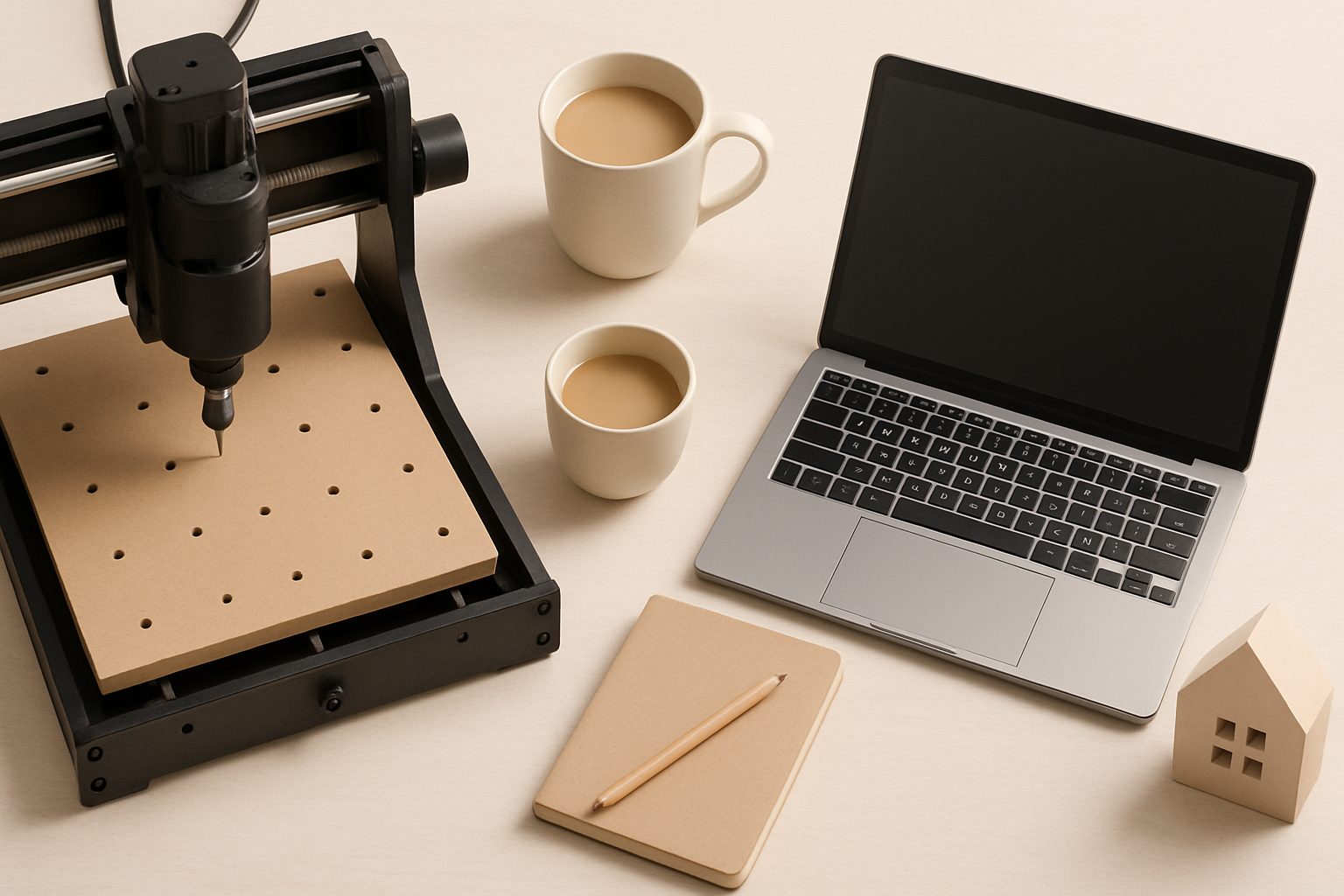
4040 CNC Router UK Review 2025: Is the 400×400mm Work Area Worth It?
A 4040 CNC router—named for its 400mm × 400mm cutting bed—sits in an awkward middle ground. It's too small for serious production work, yet serious enough that buyers expect reliability and precision. For UK hobbyists and small workshops, it's often the sweet spot: large enough to handle meaningful projects, compact enough to fit on a bench, and priced low enough that investing in one isn't financial suicide.
But whether it's worth the outlay depends entirely on what you're actually making.
What You Get for Your Money
A typical 4040 machine costs £800–£2,200 in the UK. For that, you're looking at a hardened aluminum extrusion frame (the "4040" designation refers to the 40mm × 40mm profile), a spindle rated between 500W and 2.2kW, and enough rigidity to mill soft metals and hardwoods without chatter.
The build quality varies wildly. Budget models from unknown brands ship with loose V-wheels and questionable stepper motors. Mid-range options from established makers like Genmitsu and SainSmart include decent limit switches, better bearings, and software that doesn't frustrate you immediately.
The real question isn't whether it works—most 4040 routers work—but whether it works for your tolerance of fiddling.
Genmitsu 4040-PRO vs SainSmart PROverXL 4040
These two dominate the UK market for good reason.
The Genmitsu 4040-PRO (around £1,400–£1,600 in UK pricing) offers a proven design with consistent customer support. You'll spend less time troubleshooting firmware and more time actually cutting. The spindle is adequate for MDF and pine; the dust extraction boots actually contain chips. Limit switches come pre-mounted. If you're new to CNC, this is the conservative choice. You're buying predictability.
The SainSmart PROverXL 4040 typically undercuts Genmitsu by £200–£400. That savings comes with trade-offs: the default software is less polished, the stepper motors are noisier, and the spindle is shorter on grunt. But the frame is equally rigid, and if you're willing to upgrade the control board or dial in calibration yourself, you'll end up with a machine just as capable. You're buying cheaper and accepting more tinkering.
For most UK buyers, Genmitsu wins on time-to-first-useful-project. SainSmart wins on budget-conscientiousness if you know your way around motor configuration.
The 400×400mm Work Area in Practice
This is where honesty matters: 400×400mm is smaller than you think.
A standard sheet of MDF is 2,440mm × 1,220mm. You cannot fit a 4040 in any efficient nesting pattern. A square of that size cuts a single sign, a single wooden box, or a few chess pieces per setup.
But if your work is individual pieces—wooden gifts, small signs, aluminium brackets for projects—400×400mm is generous. Most router work people claim they'll do sits comfortably inside it.
The frustration kicks in when clients ask for something just fractionally larger, or when you want to gang-cut multiple items. Then you either re-design around the limit, tile your cuts (which wastes material at seams), or accept that you need a bigger machine. This is why 6090 and 1390 machines sell so well: just enough extra bed to dodge that frustration.
For UK hobbyists, ask yourself honestly: are your typical projects smaller than a sheet of A3 paper? If yes, 4040 is fine. If no, save another £2,000 and buy bigger.
Upgrades Worth Making
A 4040 from the box is functional but constrained. Three upgrades pay for themselves quickly:
Limit switch upgrade — Standard switches are basic mechanical. For £40–£60, a set of optical or magnetic limit switches eliminates the finesse of manual homing and lets you jog reliably to the same origin point. Essential if you're cutting multiple identical parts.
T-track clamp kit — Bolting your workpiece direct to the bed is amateur. A T-track system (approximately £80–£150 for a complete kit) lets you clamp irregular shapes, stack pieces, and change setups without resurfacing. It's the difference between hobby and semi-professional.
Spindle upgrade — The included spindle is often the machine's bottleneck. A quality 2.2kW spindle (£200–£400) dramatically reduces chatter in hardwoods and opens up aluminium work. If you only ever cut MDF and pine, skip it. If you cut hardwood regularly, it's non-negotiable.
Who Should Actually Buy One
Buy a 4040 if:
- You have designs smaller than 400×400mm
- You can work around that constraint creatively
- You value precision (±0.1mm is realistic) over speed
- You're willing to spend 20 hours learning software and calibration
- You have adequate workshop extraction (a 4040 generates real dust)
Don't buy a 4040 if:
- You expect to cut full sheets or large flat stock
- You need production speed (these are slow)
- You're completely new to CNC and want a plug-and-play solution
- Your budget is under £800 (cheaper models are more frustration than value)
The Verdict
A 4040 CNC router is honest equipment. It does what it claims, without theatrical promises. It's not a replacement for a manual mill, not a path to manufacturing business, and not a toy for casual dabbling.
For UK makers with specific, modest projects and modest expectations, it's worth the money. For everyone else, it's either too small or you should spend more.
More options
- Genmitsu CNC Routers (SainSmart range) (Amazon UK)
- Shapeoko CNC Router & Accessories (Amazon UK)
- CNC Router End Mill & Bit Sets (Amazon UK)
- CNC Spindle Kits & VFD Controllers (Amazon UK)
- BobsCNC Evolution 4 & Accessories (Amazon UK)